Facelift
Conveniently located to serve the Washington D.C. Area
Jowls, deep folds, and a soft jawline don’t have to define how you look. A facelift restores youthful contours and addresses visible signs of aging, without the overdone appearance many people fear. Dr. Stephen B. Baker offers advanced facelift procedures in Washington, D.C., tailored to your unique facial structure and aesthetic goals.
What Is a Facelift?
A facelift is a facial plastic surgery procedure that rejuvenates the middle and lower thirds of the face. The overall face can be aesthetically divided into three parts: forehead, mid-face (cheek), and neck.
A facelift actually is a combination lift of the lower face and neck with the midface. Adding a forehead or brow lift would constitute a full face lift. But since aging in the midface and neck occurs more rapidly than in the forehead, not every patient who is a good candidate for a facelift or neck lift needs a forehead lift.
Facial rejuvenation surgery should be customized to each patient. The challenge is to create a natural appearance where patients look like themselves, only younger and refreshed.
Dr. Baker, a facelift surgeon in Washington, D.C., will help you choose the approach that best suits your goals. The general goal of cosmetic chin surgery is to provide a harmonious balance to your chin and facial features so that you feel better about the way you look.
What a facelift improves
A facelift targets common signs of facial aging:
- Jowls and a softened jawline
- Lower-face folds, including marionette lines and nasolabial folds
- Midface descent and loss of volume
- Loose skin along the lower face
When combined with a neck lift, the procedure can also refine the neck area. At Stephen B. Baker MD, DDS, FACS Plastic Surgery DC and McLean VA, philosophy prioritizes natural, refreshed results, never a tight or pulled appearance.
Facelift options we offer
Dr. Baker personalizes each facelift to your facial structure and aging concerns. Common approaches include:
- Deep plane facelift – This technique repositions deeper facial tissues for longer-lasting, more natural results. It addresses midface descent and provides comprehensive rejuvenation by working beneath the SMAS layer.
- SMAS facelift – This approach tightens the superficial muscular layer beneath the skin. It offers excellent correction of jowls and lower-face sagging while maintaining facial mobility.
- Mini facelift – A less extensive option for early signs of aging. It focuses on mild jowling and lower-face laxity, using smaller incisions and a shorter recovery.
- Lower facelift – Targets the jawline and lower third of the face. This option works well for patients whose primary concern is jowl formation and lost jawline definition.
During your consultation, Dr. Baker will recommend the technique that best matches your anatomy and goals.
Candidacy & Consultation
The best candidate for a facelift is a man or woman whose face and neck have begun to reveal deep creases, redundant skin, or jowls, but whose skin still has some elasticity and whose bone structure is strong and well-defined. Most patients are in their forties to sixties, but facelifts can be done successfully on people in their seventies or eighties as well. The patient’s health is more important than their age.
A facelift can help you look younger and more refreshed. It improves facial contours but does not change who you are or restore your features to their youthful state. Before deciding on surgery, carefully consider your goals and review your expectations with Dr. Baker. He will evaluate your facial anatomy and discuss which approach will deliver the best outcome during your consultation.
What to Expect Before and During the Procedure
Facelift evaluation process
Facelift consultations are highly individualized. During your consultation, Dr. Baker evaluates your facial structure, including skin quality, soft tissue volume, and underlying bone. He also discusses your concerns, goals, and expected recovery timeline.
Based on this evaluation, a personalized treatment plan is outlined to align with your goals and recovery needs. The assessment reviews all facial tissue layers contributing to visible changes. Three-dimensional predictive imaging can show realistic outcomes and support informed decision-making.
Treatment planning considers your goals, recovery availability, and budget. Dr. Baker focuses on facial anatomy rather than trend-based techniques. He provides clear guidance and may review multiple surgical approaches when appropriate.
Your medical history is reviewed carefully to identify factors that could affect surgery or healing. These factors include conditions such as high blood pressure, clotting issues, or a tendency toward scarring. If you proceed, Dr. Baker explains the recommended technique, anesthesia, surgical setting, costs, and answers any remaining questions.
What does a facelift involve?
A facelift typically takes four to five hours and may take longer if combined with other procedures. The procedure focuses on restoring facial structure rather than pulling the skin tight. Most visible facial aging comes from deeper tissues that descend over time due to gravity and reduced tissue elasticity.
During surgery, deeper facial tissues are repositioned to restore youthful proportions. Once this support is in place, the skin is gently redraped over the face. Excess skin is removed with minimal tension, helping avoid an overly tight or unnatural appearance.
Incisions are placed discreetly along the hairline and natural contours around the ears, extending behind the earlobe into the lower scalp. In some cases, a small incision beneath the chin may be added to improve neck contour. The deeper tissues are then redraped before the incisions are closed. Fat may be removed from certain areas or added to others to restore balanced facial volume.
After surgery, a small drain may be placed behind the ear to prevent fluid buildup. Light bandaging is applied to limit swelling and bruising. These measures support early healing while tissues begin to settle.
How to prepare for your facelift
Dr. Baker will give you specific instructions on how to prepare for surgery, including guidelines on eating and drinking, quitting smoking, and taking or avoiding specific vitamins and medications. Following these instructions will help your surgery go more smoothly.
If you smoke, it is essential to stop at least three weeks before and after surgery. Smoking inhibits blood flow to the skin and can interfere with the healing of your incision areas. If your hair is very short, you might want to let it grow out before surgery, so that it is long enough to hide the scars while they heal.
Whether Dr. Baker performs your facelift at Georgetown University Hospital (Washington D.C.), Inova Fairfax Hospital (Falls Church, VA), or an ambulatory surgical facility (McLean, VA), you should arrange for someone to drive you home after your surgery, and to help you out for a day or two.
Understanding facelift anesthesia
Most facelifts are performed under general anesthesia. This means you are fully asleep, pain-free, and your breathing is carefully supported throughout the procedure. Dr. Baker usually recommends this option because it allows the surgery to be performed in a controlled, predictable manner.
In some cases, lighter IV sedation may be considered. However, if a patient moves during surgery, more medication may be needed. At that point, the patient can become fully asleep without the same breathing support used during general anesthesia, which may be less safe.
To avoid this situation, Dr. Baker prefers planned general anesthesia from the start. Every facelift is performed with a board-certified anesthesiologist in a fully equipped surgical facility, with additional anesthesia support available if needed. Patient safety is the primary focus for every procedure.
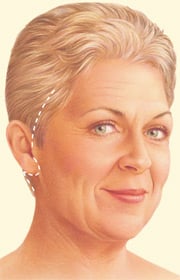
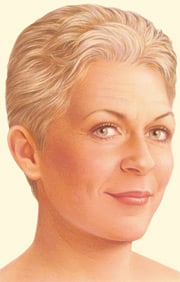
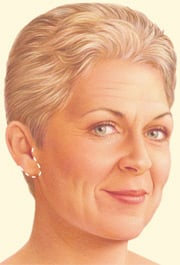
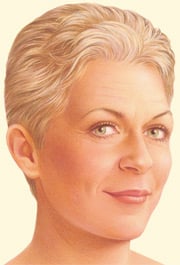
A traditional facelift incision begins in the hairline at the temples, travels around the ear and ends in the lower scalp. Fat may be sculpted, the underlying tissue is repositioned, and skin is trimmed.
Limited Incision Facelift
Facelift Recovery: What to Expect
There is usually no significant discomfort after surgery; if there is, it can be reduced with the pain medication prescribed by Dr. Baker (severe or persistent pain, or sudden swelling of your face, should be reported to Dr. Baker immediately). Some skin numbness is quite normal; it will disappear in a few weeks or months. Dr. Baker may tell you to keep your head elevated and as still as possible for a couple of days after surgery to help reduce swelling.
If you have had a drainage tube inserted, it will be removed one or two days after surgery, while bandages, when used, are usually removed after one to five days. Do not be surprised at the pale, bruised, and puffy face you see. Just keep in mind that in a few weeks, you will be looking normal. Most of your stitches will be removed after about five days, but your scalp may take longer to heal, and the sutures in your hairline could be left in a few days longer.
You should be up and about in a day or two, but plan on taking it easy for the first week after surgery. Be especially gentle with your face and hair, since your skin will be both tender and numb, and may not respond normally at first.
Dr. Baker will give more specific guidelines for gradually resuming your normal activities. They are likely to include these suggestions: avoid strenuous activity (including sex and heavy housework) for at least two weeks (walking and mild stretching are fine); avoid alcohol, steam baths, and saunas for several months. Above all, get plenty of rest and let your body use its energy to heal.
Returning to normal
At the beginning, your face may look and feel rather strange. Your features may be distorted from the swelling, your facial movements may be slightly stiff, and you will probably be self-conscious about your scars. Some bruising may persist for two to three weeks, and you may tire easily.
By the third week, you will look and feel much better. Most patients are back at work about ten days to two weeks after facelift surgery. If you need it, special camouflage makeup can cover most remaining bruising.
Embracing your new look after a facelift
The chances are excellent that you will be happy with your facelift, especially if you realize that the results may not be immediately apparent. Even after the swelling and bruises are gone, the hair around your temples may be thin, and your skin may feel dry and rough for several months. Men may find they have to shave in new places-behind the neck and ears-where areas of beard-growing skin have been repositioned.
You will have some scars from your facelift, but they are usually hidden by your hair or in the natural creases of your face and ears. In any case, they will fade over time and should be scarcely visible.
Having a facelift does not stop the clock. Your face will continue to age with time, and you may want to repeat the procedure one or more times, perhaps five or ten years down the line. But in another sense, the effects of even one facelift are lasting; years later, you will continue to look better than if you had never had a facelift at all.
Benefits of Getting a Facelift
A facelift offers several advantages for patients seeking facial rejuvenation:
- Restores a defined jawline and reduces jowls
- Smooths deep folds and wrinkles in the lower face
- Provides long-lasting improvement that ages naturally with you
- Enhances facial harmony without looking “done”
- Addresses multiple signs of aging in one procedure
- Boosts how you feel when you look in the mirror
Many patients report feeling more comfortable and satisfied with their appearance after recovery. The goal is to help you look like yourself, just more refreshed.
Cost of a Facelift Procedure
Facelift costs vary based on several factors, including the technique used, the extent of correction needed, anesthesia fees, and facility fees. Deep plane and full facelifts typically cost more than mini or lower facelifts due to their greater complexity and the time required.
During your consultation, Dr. Baker will provide a detailed estimate based on your specific treatment plan. He believes in transparency about costs so you can make an informed decision.
Why Choose Dr. Baker’s for Your Facelift Procedure?
Here are the top reasons patients trust Dr. Stephen Baker as their facelift surgeon:
- Professor of Plastic Surgery, Medstar Georgetown Department of Plastic Surgery
- Director, Medstar Georgetown Center for Facial Restoration
- Authored multiple peer-reviewed manuscripts on facial rejuvenation
- Face Q pioneer and expert on outcomes studies in patient satisfaction in facial aesthetic surgery, including facelift (one of several practices in the United States selected to participate in this study funded by the Plastic Surgery Foundation).
- Training in plastic, maxillofacial, and craniofacial surgery equips him to perform a comprehensive assessment of each patient’s facial structure. He is trained in all modalities for addressing your problems, so he is not limited in the solutions he can provide.
Frequently Asked Questions
Book a Consultation with Dr. Baker Today
You deserve to feel as vibrant as you are. If you’re considering a facelift to restore a more youthful, refreshed appearance, schedule a consultation with Dr. Stephen B. Baker in Washington, DC. With extensive experience in facial rejuvenation procedures, Dr. Baker will evaluate your goals and design a personalized surgical plan to help you achieve natural-looking, long-lasting results. Call 202-444-7073 today or fill out the form to book your consultation.
Articles
As Featured In